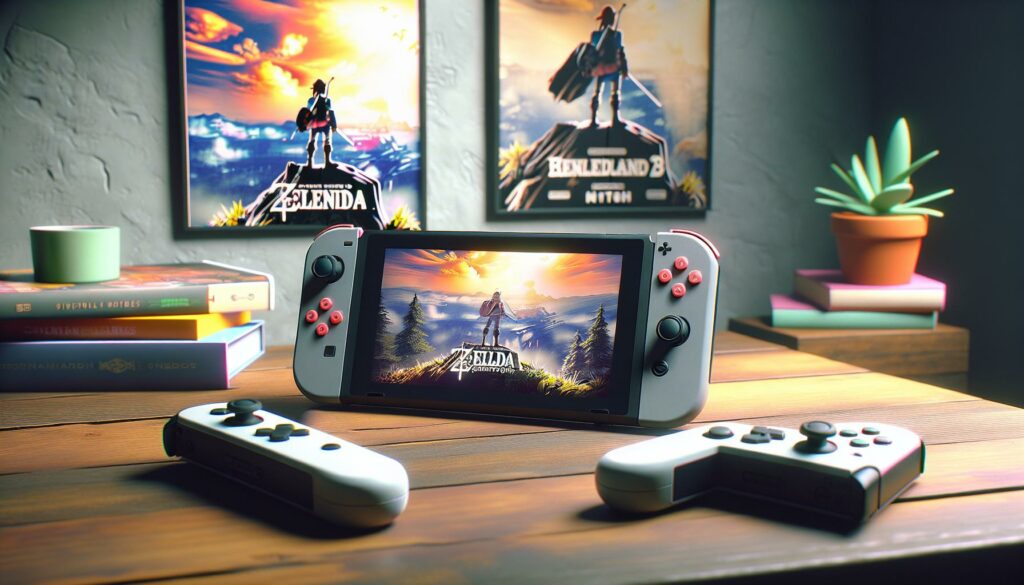

When the Nintendo Switch V1 launched in March 2017, it fundamentally changed how people thought about gaming hardware. Here was a console that could transform from a portable handheld into a docked home system with a flick of the wrist, no docking station swap, no cables to fiddle with, just intuitive design that worked. Seven years later, the original Switch remains the gold standard for hybrid gaming, having moved over 139 million units worldwide and spawned an entire ecosystem of games, accessories, and memories for millions of players. Whether you’re a collector hunting for launch models, a gamer curious about what made the Switch so special, or someone wondering how the original holds up today, this guide covers everything you need to know about Nintendo’s console that proved home and portable gaming didn’t have to be mutually exclusive.
Key Takeaways
- The Nintendo Switch V1 revolutionized gaming by seamlessly combining portable handheld and docked home console experiences through innovative Joy-Con controllers and intuitive hybrid design.
- The original Switch’s custom NVIDIA Tegra X1 processor delivered sufficient power (720p handheld, 1080p docked at 30fps) to run contemporary games without sacrificing portability or battery life.
- Battery life for the Nintendo Switch V1 ranged from 4.5–6.5 hours depending on game intensity, with later revisions extending this to 5.5–9 hours through optimized power delivery.
- The launch with The Legend of Zelda: Breath of the Wild established the Switch as a legitimate platform for AAA ports and indie games, proving design could outmuscle raw specifications.
- Mint-condition V1 units command collector value ranging from $250–$400 in 2026 due to historical significance, rarity, unique launch-color Joy-Cons, and appeal to homebrew communities.
- Joy-Con drift emerged as the V1’s defining hardware flaw, with analog stick degradation persisting across revisions and resulting in Nintendo settling class-action lawsuits.
What Made The Original Nintendo Switch Different
The Nintendo Switch V1 wasn’t revolutionary because Nintendo invented hybrid gaming, it was revolutionary because the company actually nailed the execution. Before 2017, hybrid consoles felt like gimmicks. The Switch made it feel inevitable.
The core brilliance was in the Joy-Con controllers. Unlike a typical laptop hinge or flip phone design, the Switch used sliding controllers that detached completely from the tablet. This meant portability without sacrificing a proper controller grip, and docked gameplay without feeling like you’re holding a portable device. It sounds simple, but the execution removed friction from the user experience in a way competitors couldn’t replicate.
Nintendo also timed the release perfectly. The Switch arrived with The Legend of Zelda: Breath of the Wild, a game that redefined open-world design and immediately proved the console’s power wasn’t the limiting factor, the design was the star. Within the first year, third-party developers ported everything from indie darlings to AAA franchises. Suddenly, games like DOOM, The Witcher 3, and Fortnite on a device you could take to bed or on a flight wasn’t just possible, it was expected.
The hardware itself was impressive for 2017: a custom NVIDIA processor, 4GB of RAM, and 32GB of storage gave it enough muscle to run contemporary games at 720p handheld and 1080p docked. It wasn’t the most powerful console ever, but it didn’t need to be. The Switch proved that creativity and design could outmuscle raw specs when it came to market appeal and longevity.
Hardware Specifications And Performance
The Nintendo Switch V1 runs on a custom NVIDIA Tegra X1 processor paired with 4GB of RAM and 32GB of internal storage (expandable via microSD up to 2TB with the right adapter). The design was intentional: enough power to run current-gen games, not so much power that battery life suffered catastrophically. For context, the PS4 and Xbox One shipped with 8GB of RAM, but the Switch was designed for portability, different goals, different tradeoffs.
Processor And Graphics Capabilities
The custom Tegra X1 inside the Switch V1 delivered Maxwell-based graphics with 256 CUDA cores. In practical terms, this meant 1080p docked performance at 30fps for most AAA ports, and 720p handheld at the same frame rate. It wasn’t cutting edge for 2017, but it was versatile enough to scale down. Games like DOOM ran at 720p/30fps handheld and 1080p/30fps docked, while lighter titles like Mario Kart 8 Deluxe hit 1080p/60fps docked.
The handheld GPU clock was 307.2 MHz, while docked clocking pushed to 768 MHz. That thermal headroom was crucial: running the same silicon at different speeds in two configurations avoided the “fan screaming” problem that plagued some hybrid devices. The architecture also supported Vulkan, which meant developers could optimize beyond Nintendo’s built-in APIs if they wanted lower-level control.
Display Technology And Screen Quality
The Switch V1’s screen was a 6.2-inch LCD panel with 1280×720 resolution at 268 pixels per inch. It wasn’t an OLED (that came with the 2021 revision), and it wasn’t IPS-grade viewing angles, but for the time and the use case, it worked. The screen had capacitive touch support, though surprisingly few games used it beyond menu navigation.
Portability meant brightness mattered more than perfect colors. Nintendo tuned the display for outdoor visibility, which sometimes meant indoor colors looked slightly oversaturated. Viewing angles weren’t terrible, but they weren’t smartphone-quality either. The trade-off made sense: you’re holding the thing, not sharing a screen across a couch.
Refresh rate was a fixed 60Hz, which meant motion clarity was decent but not exceptional. Fighting game communities noticed frame delivery inconsistencies, and competitive titles sometimes had slight input lag from the touch layer (though you could ignore touch entirely in most games).
Battery Life And Power Management
This is where the Switch V1 showed its age quickest. The original battery pack was a 4310 mAh unit that delivered 4.5–6.5 hours of gameplay depending on the title. Demanding games like The Legend of Zelda: Breath of the Wild drained it faster: lighter games like Pokemon Let’s Go lasted longer.
The second hardware revision (released in August 2019, sometimes called the “V2” or “HAC-001(-01)”) bumped the battery to 4310 mAh but optimized the power delivery, extending life to 5.5–9 hours. The original V1 owners often invested in external battery packs or docking stations out of necessity, especially for travel.
Thermal management was adequate. The Switch didn’t throttle noticeably under normal gaming conditions, though sustained play in docked mode could cause the chassis to warm up. Nintendo’s design kept vents clear and never let thermals become a dealbreaker, unlike some competing tablets and portable systems. The CPU and GPU shared a thermal interface, which meant heat dissipation was efficient but also meant a single thermal bottleneck could impact both, rarely an issue in practice, but worth mentioning for the technically curious.
The Hybrid Console Design: Handheld And Docked Modes
The magic of the Switch V1 was the fundamental design premise: one device, three ways to play. Handheld mode meant you unplugged the Joy-Cons and held the tablet. Tabletop mode meant you propped the screen up with the kickstand (a famously wobbly piece of plastic) and played with detached controllers. Docked mode meant the tablet slid into the dock, controllers went into a grip, and you got TV output.
No other major console offered this flexibility. The PS Vita had remote play to a PS4, but that was streaming, not native portability. The Wii U had a tablet but required it to stay within range of the home console. The Switch was the console, in whatever configuration you wanted.
This wasn’t just a gimmick for marketing. The design had real implications for game library. Indies that thrived on portability found a home. Games designed for controllers-in-hand, like Mario Party Superstars and Super Smash Bros. Ultimate, felt natural. AAA ports worked because developers knew they could target handheld first and scale up, rather than compromise for lowest-common-denominator hardware.
The dock itself was inert, basically a USB-C connector, HDMI pass-through, and power delivery. It didn’t process anything: it just relayed signals. This meant cheap third-party docks proliferated, though some were more dangerous than others (early third-party docks bricked systems due to poor power management, a cautionary tale about why you shouldn’t skimp on the hardware).
Tabletop mode was underutilized by most players but brilliant for specific scenarios. Ring Fit Adventure used it. Nintendo Switch Sports worked beautifully. Games that benefited from Joy-Con detachment shined here, and it proved the design philosophy could adapt to use cases Nintendo probably didn’t fully anticipate at launch.
The hybrid design also meant compromises. The tablet was heavier than a typical handheld. The bezels were thicker than phones. The processing power was split between two configurations rather than optimized for one. But these weren’t bugs, they were the intentional trade-offs of a system designed for adaptability over perfection in any single mode. That philosophy defined the Switch’s entire lifecycle and Is Nintendo Switch Online Worth It became central to how players engaged with the console.
Joy-Con Controllers: Innovation And Functionality
The Joy-Cons were the solution to a problem that didn’t officially exist until Nintendo solved it: how do you make a portable console feel like a home console without sacrificing portability? The answer was modular controllers that worked in multiple configurations.
Design Features And Build Quality
Each Joy-Con was roughly the size of a half-bar of soap, with a D-pad or buttons on the face (left had D-pad, right had buttons), analog stick, shoulder buttons, and accelerometer/gyroscope hardware built in. The design was intentionally asymmetrical, the left and right weren’t mirror images, which meant they could fit different hand positions.
The original color was Neon Red and Neon Blue, though the console shipped with gray variants at launch too. The plastic construction was solid enough, though it wasn’t premium-feeling, it was durable but hollow-sounding when tapped. The grip was rubberized, which helped prevent slippage during portable play.
Build quality for the V1 controllers was… mixed. Joy-Con drift became the defining hardware issue of the entire Switch generation. The analog sticks used potentiometer-based sensors that degraded over time, sometimes within weeks of use. Nintendo eventually settled class-action lawsuits over this, and the issue persisted into later Joy-Con revisions. The V1 controllers were not immune, though some units lasted years without problems (RNG strikes again).
The battery inside each Joy-Con was 1020 mAh, giving roughly 20 hours of use per charge. You charged them either via the dock or a USB-C cable, or by sliding them back onto the console to top up. The design meant you could always have a spare pair charging while you played.
Motion Controls And Haptic Feedback
Built into each Joy-Con were accelerometers and gyroscopes, enabling motion controls that ranged from gimmicky to essential depending on the game. The Legend of Zelda: Breath of the Wild used gyro aiming for bow controls, clunky in motion mode, but brilliant with gyro aiming. Mario Kart 8 Deluxe let you steer by tilting, which was fun but not competitive. 1-2-Switch was basically a tech demo of motion controls and nothing more.
The standout was Ring Fit Adventure, which used motion tracking so consistently that the Joy-Cons became fitness trackers. That was creative integration, not forced motion controls.
Haptic feedback was less celebrated but more important. The Joy-Cons had rumble motors that delivered subtle vibration. Early implementations were crude, but games like Fire Emblem: Three Houses and Animal Crossing: New Horizons used haptic feedback to indicate UI interactions, creating a tactile response that felt satisfying without being overwhelming.
The rumble wasn’t DD (Direct Drive) haptics like the PS5 DualSense, but it was sufficient. You could feel gravel under car tires in racing games, or the subtle feedback of selecting items. It wasn’t precision-engineered immersion, but it was present and appreciated.
Launch Titles And Game Library Impact
The Switch V1 launched with a lineup that, in hindsight, was lean but perfectly curated. The Legend of Zelda: Breath of the Wild was the tent-pole title, and it alone justified buying the console. This was a game that redefined open-world design and proved the Switch wasn’t a compromise, it was a different approach. The fact that it ran on both a handheld and a docked system without compromise was incredible.
Beyond Zelda, there was 1-2-Switch, a tech demo that showed off Joy-Con functionality. It was fun at parties, forgettable after a week. Just Dance 2017 launched same-day, Bomberman R, Puyo Puyo Tetris, and a few others rounded out the physical launch window.
But here’s what made the Switch library explode: portability changed expectations. Developers realized they could port games that were “too big” for handhelds. DOOM released in November 2017 and ran at 720p/30fps handheld. The Witcher 3 came later and proved scope wasn’t a barrier. Fortnite on Switch meant a friend could pull out their console mid-conversation and squad up.
Indie developers embraced it faster than AAA studios. Celeste, Hollow Knight, Stardew Valley, Hades, games that thrived on short play sessions found their perfect platform. The eShop became the engine of the ecosystem, with Indies driving engagement and word-of-mouth in ways traditional retail couldn’t.
By 2019, the Switch had become the fastest-selling console ever, with third-party support surpassing even Nintendo’s expectations. Nintendo exclusives like Super Mario Odyssey, Mario Kart 8 Deluxe, Splatoon 2, and eventually Animal Crossing: New Horizons cemented the library as essential. The game library didn’t win because of graphics, it won because games felt made for the platform.
Original Switch V1 Vs Later Models: Key Differences
Nintendo released several revisions of the Switch, and understanding the V1’s place in that evolution helps explain why collectors still hunt for original models.
Hardware Revisions And Improvements
The first revision came in August 2019, sometimes labeled the V2 or HAC-001(-01). The changes were subtle but meaningful:
- Battery: Upgraded from 4310 mAh to the same capacity but with optimized power delivery (revised Tegra X1). Battery life extended from 4.5–6.5 hours to 5.5–9 hours depending on usage.
- Processor: The new Tegra X1+ had improved power efficiency, reducing heat and extending docking performance ceilings.
- Joy-Con drift: Still present in the revision, even though optimism that it was fixed. Nintendo later offered repairs and eventually redesigned the stick mechanism in later controllers, but the V1 and V2 Joy-Cons had the same vulnerability.
- Dock design: Minor tweaks, but functionality remained identical.
The Nintendo Switch Lite arrived in September 2019, stripping away dockability and Joy-Con detachment for a $199 handheld-only console. Smaller screen, lighter weight, no TV output. It was the anti-Zelda-launch console, designed for casual play and portability, not power or versatility.
The Nintendo Switch OLED launched in October 2021, bringing a 7-inch OLED screen, better speakers, and improved kickstand. The processing power remained identical to the V2, but the screen was the draw. OLED meant better colors, contrast, and viewing angles. The kickstand became a proper mechanism instead of a flimsy hinge.
Here’s the nuance: the V1 and V2 are nearly identical in gaming performance. The V1 had slightly worse battery life and ran marginally hotter, but the difference wasn’t dramatic. The OLED is genuinely better for screen quality but plays games identically to the V1. The Lite is a different product category, handheld-only, no docking.
For collectors, the V1 remains valuable because it’s the original. Early revision consoles with unpatched CPU exploits became targets for homebrew enthusiasts, adding another layer to collector value. The combination of historical significance, unique Joy-Con colors (Neon Red/Blue were exclusive to launch), and rarity of mint-condition units keeps V1 prices elevated in the used market. Gameslot545 has Top Benefits of Buying a Used Nintendo Switch Console that digs into the economics of picking one up pre-owned.
Why Collectors And Gamers Still Value The Original
Seven years post-launch, the Switch V1 commands respect and collector value for several reasons that go beyond nostalgia.
Historical significance is the foundation. This was the console that changed Nintendo’s direction forever. It proved hybrid gaming wasn’t a gimmick. Every Switch sold since, over 139 million units, traces back to the bet Nintendo made with the V1 design. Mint condition launch units, especially with original packaging and untouched controllers, are collecting pieces.
Rarity of pristine condition drives value. Most V1 units sold in 2017 have been used, modded, or worn. Consoles that remained sealed or gently played are increasingly scarce. Launch day models with serial numbers confirming manufacturing date are the most sought-after.
Joy-Con color variants matter to collectors. Neon Red/Blue and gray were launch colors, but gray sold out first and became harder to find. Later revisions came with different color options, making the original color combos rarer. Custom colored controllers were rare back then, making V1-specific color pairs valuable.
Homebrew and emulation communities prize early V1 units. The original batch had unpatched boot ROM exploits that enabled custom firmware installation, turning the Switch into a retro gaming machine. Later units and revisions closed these exploits, making unpatched V1 consoles valuable to that community. Major gaming outlets like Kotaku have covered the modding scene extensively, though we should note that installing custom firmware voids your warranty and may violate terms of service.
Nostalgia and authenticity are real. Gamers who bought a Switch in 2017 and played Breath of the Wild remember the feeling. An original V1 console today is a time capsule, it captures that moment when gaming fundamentally shifted. For players who grew up with it, owning the exact device they remember is worth the premium.
The V1 also benefits from the Switch’s longevity. Seven years in and the console still has a thriving game library, active online communities, and regular releases. Unlike some early consoles that aged into obscurity, the Switch remains contemporary, which means V1 owners can still enjoy new games. That sustained relevance increases collector value because the device isn’t purely nostalgic, it’s still functional in a living ecosystem.
Price-wise, a mint condition V1 in 2026 ranges from $250–$400 depending on condition and color rarity. That’s above what the console originally cost ($299), but well below the inflated prices of the early pandemic shortage era (2020–2021). For comparison, the OLED retails at $349, so a used V1 is competitive on price while offering retro authenticity.
Conclusion
The Nintendo Switch V1 is more than a console from 2017, it’s a landmark in gaming hardware design. It proved that innovation doesn’t require the most powerful specs or the fanciest screens: it requires solving a real problem elegantly. Nintendo asked “what if you didn’t have to choose between home and portable gaming?” and delivered a complete answer in the form of Joy-Cons, a hybrid dock, and a library that validated the concept immediately.
By today’s standards, the V1 shows age in battery life and hasn’t benefited from OLED’s screen improvements. The Joy-Con drift issue remains its most persistent flaw. But playing a current AAA game on the original console that proved such things were possible carries weight. Whether you’re hunting for a mint-condition launch unit for your collection, curious about where the Switch philosophy started, or simply interested in gaming hardware history, the V1 represents a specific moment when Nintendo took an enormous risk and fundamentally changed the industry.
The Switch ecosystem has evolved, the Lite offers portability, the OLED offers luxury, and the upcoming Switch 2 will likely push processing power. But the V1 remains the original statement, the proof of concept, and the console that turned a hybrid idea into a mainstream reality. For that reason alone, it endures.